Customer acquisition
How much should a small business spend on marketing?
Start from the customers you can take on. Check the 5 to 9% last: surveys measured large and US firms

A small business should spend on marketing what it costs to win the new customers it can take on. The latest surveys put marketing budgets at 5 to 9% of revenue, but they measure large and US companies. The SBA's 7 to 8% rule sits in a worksheet whose footnote marker leads nowhere.
Work the budget out from your capacity and what a new customer may cost, then use the percentage as a check. Further down you'll find a 6-line budget template and when demand peaks for roofing, solar and dental implants.
Marketing budget percentage of revenue: who the surveys measured
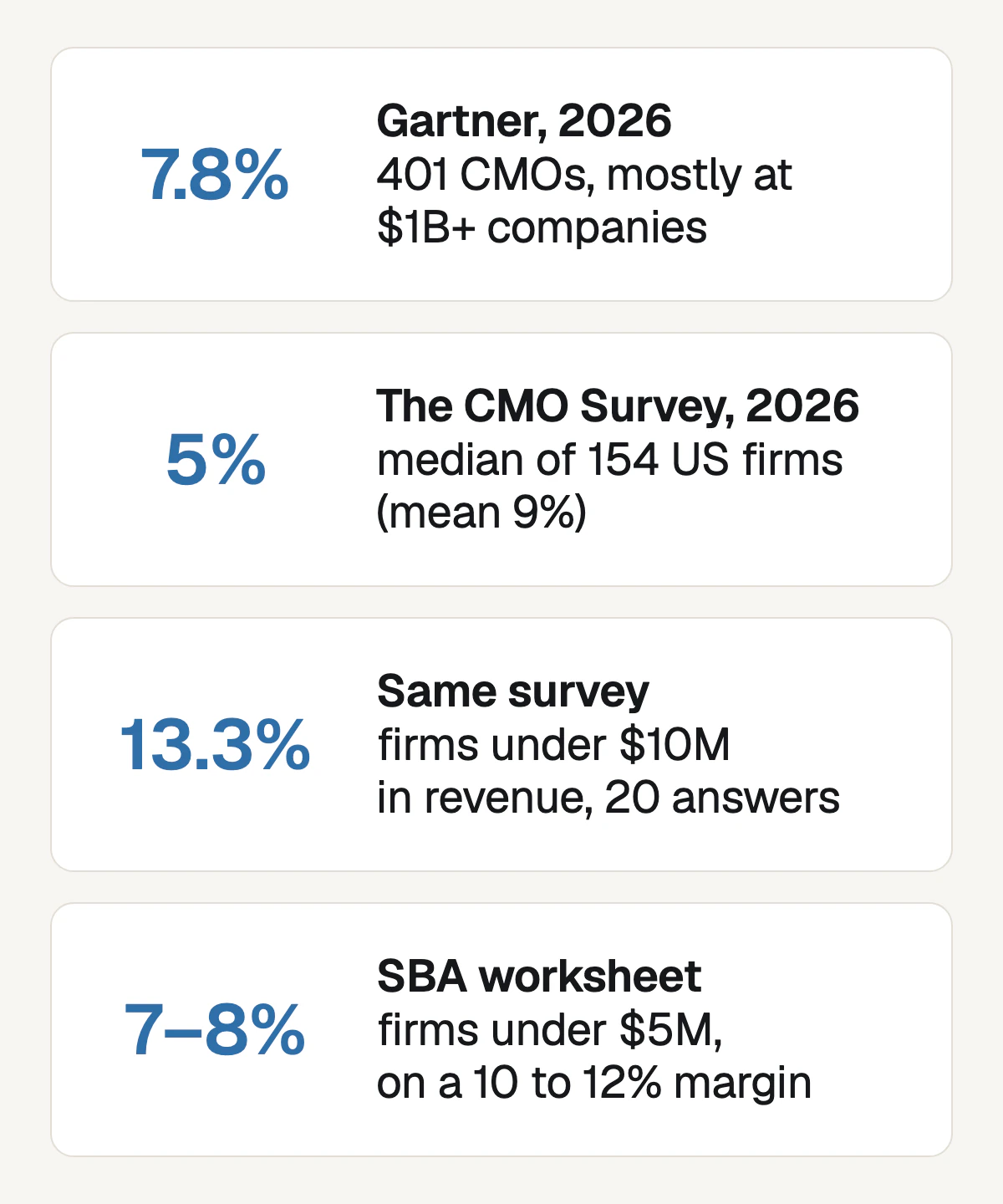
You'll meet 4 numbers in articles on this question and each comes from a different sample.
Gartner: 7.8%, from big companies. Gartner's CMO Spend Survey 2026 puts marketing budgets at 7.8% of company revenue, up from 7.7% in 2025. The answers come from 401 CMOs and marketing leaders in North America, the UK and Europe, most of them at companies with more than $1 billion in annual revenue (Gartner, May 2026.
The CMO Survey: a mean of 9%, a median of 5%. The CMO Survey 2026, run by Duke University's Fuqua School of Business with Deloitte and the American Marketing Association, asks US companies the same question. The mean came out at 9.0% of revenue and the median at 5%: half of the 154 companies that answered spend 5% or less. A few big spenders pull the mean up and the top answer was 43%. In 2025 the median was 3% (Topline Report 2025).
The smallest firms report more. In the same survey, companies under $10 million in revenue spent 13.3% on average, from 20 answers. Companies with fewer than 50 employees spent 16.3%, from 23 answers (Firm and Industry Breakout Report 2026). With 20 and 23 answers, treat both as a hint.
The SBA rule: 7 to 8%, on a 10 to 12% margin. The figure appears in a worksheet on the US Small Business Administration's Ascent learning platform. It tells businesses under $5 million in revenue to put 7 to 8% of revenue into marketing, inside a wider range of 2 to 20%, with the top end for launching something new.
The rule assumes margins of 10 to 12% after all expenses, marketing included. The footnote marker after the figure leads to no footnote (SBA worksheet, archived copy.
The SBA's current guide to marketing and sales gives no percentage. It asks for a full breakdown of what your marketing plan costs and for a comparison of those costs with the revenue they bring in.
None of the 4 looks at clinics or home improvement companies as a group. Use them to check a budget you've worked out yourself.
Monthly marketing budget: start from the customers you can serve
A percentage runs backwards, as the free textbook Principles of Marketing from OpenStax points out: you let last year's sales set the marketing that should produce next year's.
Marketing textbooks call the alternative the objective-and-task method: decide what the budget has to achieve, then price the work. The OpenStax textbook calls it "perhaps the best method" and notes that it's the least used (Principles of Marketing, section 13.4). In the SBA's own guide, the worked example is an auto repair shop whose owners aim for a set number of new customers each month.
For a clinic or a home improvement company, the objective is new customers and the budget comes from 3 numbers:
- Capacity. How many new customers can you take on per month with the chairs, clinicians or crews you have?
- What a new customer may cost. Work the ceiling back from what a customer is worth.
- The monthly budget. Capacity times cost per customer, with all 6 lines of the template below included.
Worked example, with made-up numbers: a roofing company has room for 4 more jobs a month and will pay up to $1,000 to win one. Its marketing budget is $4,000 a month. On $800,000 a year in revenue, that's 6%, inside the range the surveys found.
Only now compare with the surveys. If you land far above them, check your capacity and what a customer is worth before you spend.
What a marketing budget should include: 6 lines, ads are one
Ad spend goes to the ad platforms and you need the other 5 lines to turn that money into bookings. The large companies in Gartner's 2025 survey spent 30.6% of their marketing budget on paid media, or 2.4% of revenue (Gartner, May 2025).
| Line | What goes in |
|---|---|
| 1. Ad spend | What you pay the ad platforms each month |
| 2. Content | Video and photos from your own business |
| 3. The page | The landing page or website the ads send people to |
| 4. Reply and follow-up | Who answers a new inquiry, how fast and who calls back |
| 5. CRM and tools | Where every lead and booking lands |
| 6. Agency or your own time | The fee, or the hours you put in yourself |
Line 4 is about speed. A lead is never warmer than the minute it sends the form, phone still in hand. In our system, a new lead in most industries gets a call within seconds of opting in, 7 days a week. Dental clinics are the exception: there the first touch is a text in under 5 minutes and then a person follows up.
On line 6, put what the agency costs, or what your own hours are worth. Ask the agency how many hours a week the fee buys. Our answer: 4 agents we built, on your account 24 hours a day. Every decision stays with a person on our team.
We put a small budget into one campaign and one ad set with several ads built on genuinely different concepts. Split across several ad sets, each one gets too little. Meta's own help page says an ad set that's unlikely to get about 50 optimization events in a week becomes learning limited and lists combining ad sets as one fix (Meta Business Help Center, read October 2026).
Some lines cost no ad money. A clinic's existing patients can book again without a single ad, as part 3 of how to get new dental patients shows.
Is marketing tax deductible? Yes, with limits on entertaining
In the UK, the government's guide for the self-employed lists advertising and website costs among the marketing costs you can claim. You usually can't claim for entertaining clients and giveaways top out at £50 per person per tax year (GOV.UK, marketing and entertainment, read October 2026).
In the US, IRS Publication 334 lists advertising among the business expenses you may be able to deduct and entertainment among the ones you usually can't (IRS, Publication 334).
In Sweden, Skatteverket says advertising, PR and marketing are normally deductible, while a client meal gets no deduction (Skatteverket, deductions for companies).
This isn't tax advice, so check with your accountant.
When to spend your marketing budget: seasonality by trade
We pulled 5 years of Google Trends data, October 2021 to September 2026 and compared each month with that year's average: Sweden over 2022 to 2025, the US over 2022 to 2024, because the US series about doubles from mid-2025.
| Search, country | Peaks and troughs |
|---|---|
| Roof replacement, Sweden (takbyte) | Highest February to May and August to September, lowest November to January. August runs at about 3 times November |
| Roof replacement, US | Highest June to August, lowest November and December. The busiest month runs about 40% above the quietest |
| Solar panels, Sweden (solceller) | Highest in March and August to September, lowest November and December |
| Solar panels, US | Highest April to August, lowest November and December |
| Dental implants, Sweden (tandimplantat) | Level all year, lowest in July |
| Dental implants, US | Level all year |
These figures cover searches only and ad prices are a separate number.
Keep spending when sales slow. An article on the SBA's blog calls it a chicken-and-egg problem: sales drop, you cut marketing and sales drop further (SBA, 2019).
Companies cut there anyway. In The CMO Survey 2026, 53.1% of companies turned to cutting costs when profits fell short and when they did, they cut marketing 45.4% of the time, more often than other expenses. The same marketers put the median impact of their marketing at 6 months (Highlights and Insights Report 2026), so a cut in a slow month can show up as gaps in the calendar for months after.
How much should a roofing company spend on marketing?
The latest public figure for remodelers is old. In the National Association of Home Builders' Remodelers' Cost of Doing Business study, built on 2011 accounts, sales and marketing took 3.2% of revenue, sales staff pay included. The average net profit margin was 3.0% (NAHB, 2013 presentation). The SBA's 7 to 8% rule assumes margins 3 to 4 times that.
In spring you turn work away. In October the phone goes quiet and the crew you kept on sits idle. Both are the same problem: nothing you can switch on when you need it.
The campaigns we run for home improvement companies need an ad budget of at least 12,000 SEK a month. When the season starts, we lift the winning ad's budget in steps, a few days apart. Keep the campaigns running through the quiet months too, because a big decision takes time:
60
Nobody decides on a house in a week. This is how we run home improvement lead generation.
How much should a dental practice spend on marketing?
The American Dental Association publishes no marketing share: the public tables from its 2025 Survey of Dental Practice report practice expenses as totals (ADA, dental practice research).
Worked example, made-up numbers: a practice has 15 consultation slots a month to fill with new patients and will pay up to $200 to win one. Its monthly budget is 15 times $200, or $3,000.
Searches for dental implants hold steady through the year in Sweden and the US, with a July dip in Sweden, so you can keep the monthly budget steady too. Aesthetic treatments move more: Swedish searches for botox peak from March to May and dip in July.
If your chairs are booked solid for months ahead, more consultations won't help. Fix capacity or pricing first.
This is how we run marketing for dental clinics and aesthetic clinics. Here's how it looks at one of the dental clinics we do this for:
50
Straight answers to common questions
What percentage of revenue should a small business spend on marketing?
The latest surveys land on 5 to 9% of revenue, measured on large and US companies. The SBA's 7 to 8% rule assumes margins of 10 to 12%, so check your own margin before you borrow the figure. Work your budget out from capacity and cost per customer first, then compare.
How much should a small business spend on marketing per month?
Multiply the new customers you can take on in a month by what one may cost you and include every line: ads, content, the page, follow-up, tools and agency fees. In the worked example above, 4 jobs at up to $1,000 each come to $4,000 a month.
What is a good marketing budget for a small business?
One that fills the capacity you have at a cost per customer you can afford and keeps running through the slow months. As a check, the median US company in The CMO Survey 2026 spent 5% of revenue and the smallest firms in that survey reported more.
What is the 70/20/10 rule for a marketing budget?
A rule for splitting a budget you already have: about 70% on what already works, 20% on newer bets and 10% on experiments. It says nothing about how big the budget should be and we found no study that tested it on marketing budgets.
What should a marketing budget include?
6 lines: ad spend, content, the page the ads lead to, reply and follow-up, CRM and tools and agency fees or your own time. Some of the cheapest bookings come from places that need no ad money, such as reviews and the customers already in your register.
How much of a marketing budget should go to an agency?
There's no set share: the fee is line 6 of the budget. You'll usually meet 2 tiers. The $2k agency spends about 20 minutes a week on your account. The $10k agency does great work, slowly and expensively. Our answer: no price list, because the structure changes with the business. What's fixed: results-based, weighted to what a booked appointment is worth to you, no lock-in. You get a straight number on the call, before you commit to anything.

Author
Oscar Cruz
Founder, Leadflix
Leadflix started when our founder, Oscar Cruz, saw that most gyms and trainers were terrible at marketing and started fixing it. Clinics and home improvement came next, where 1 new customer is worth enough that the math changes: fill the calendar and the business grows. 80+ businesses, $7M in client revenue and 40,000+ sales appointments later, that is still the whole job.
Articles by Oscar