Customer acquisition
Zocdoc alternatives for providers: what each fixes, and how Zocdoc charges
Zocdoc charges per new patient its Marketplace books. What each alternative fixes, and what it leaves with you

These 4 Zocdoc alternatives for providers each fix a different problem. Smith.ai answers the calls your front desk misses, athenahealth handles scheduling and messages mostly for the patients you already have, Tebra puts online booking on your own website, and Leadflix runs ads and books new patients into your calendar. Zocdoc itself charges a one-time fee for each new patient who books through its Marketplace or partner sites.
Zocdoc's pay-per-booking page gives no amount, so whether it pays comes down to arithmetic only your practice can run, and Zocdoc publishes the formula.
We're Leadflix, one of the Zocdoc competitors on this list, so we describe every tool from its own website and judge each one on the same 2 lines: what it fixes, and what it leaves with you.
Zocdoc pricing for providers: a fee per Marketplace booking
Zocdoc is a marketplace where patients find a provider and book online, and for providers its model is pay per booking. It charges a one-time fee only when a new patient books through the Zocdoc Marketplace or one of its partner sites, and it charges at the moment the patient books (Zocdoc, pay-per-booking fees, read October 2026). There's no subscription and no minimum spend, and the page names no amount: "The amount varies by specialty and location."
The rules that decide your bill, from the same page:
- Existing patients don't count, even when they book through the Marketplace.
- Zocdoc treats the fee as a marketing fee, so it charges at booking and the outcome of the visit doesn't change it.
- If a patient cancels within 24 hours of booking, Zocdoc may waive the fee, but it doesn't promise to.
- If a patient who has already seen you through Zocdoc books as new, you have 7 days to file a claim, and Zocdoc credits the booking once it's confirmed.
- You can set a monthly spend cap, pause spending, or turn individual providers off. Sponsored Results charges don't count toward the cap.
- Booking through Zocdoc's Book Online Button on your own website, or a Book Online button on your Google Business Profile, carries no fee.
Paid placement is a separate line: Zocdoc bills Sponsored Results, its paid spots in Marketplace search, apart from the booking fees. For certain partner sites it also enrolls providers by default, and you can opt out at any time (Zocdoc, transparency for providers, read October 2026).
Is Zocdoc worth it for providers? Run its own numbers
It is when the fee and the admin time per kept patient come in under your other channels and under what that patient is worth. Zocdoc's own answer is that this depends on your specialty, how long your patients stay and local demand, rather than on the booking fee alone (Zocdoc, cost and value, read October 2026). Its method values a new patient as revenue per completed visit, times the expected number of visits, times the share you collect, and then subtracts the booking fee and the admin cost.
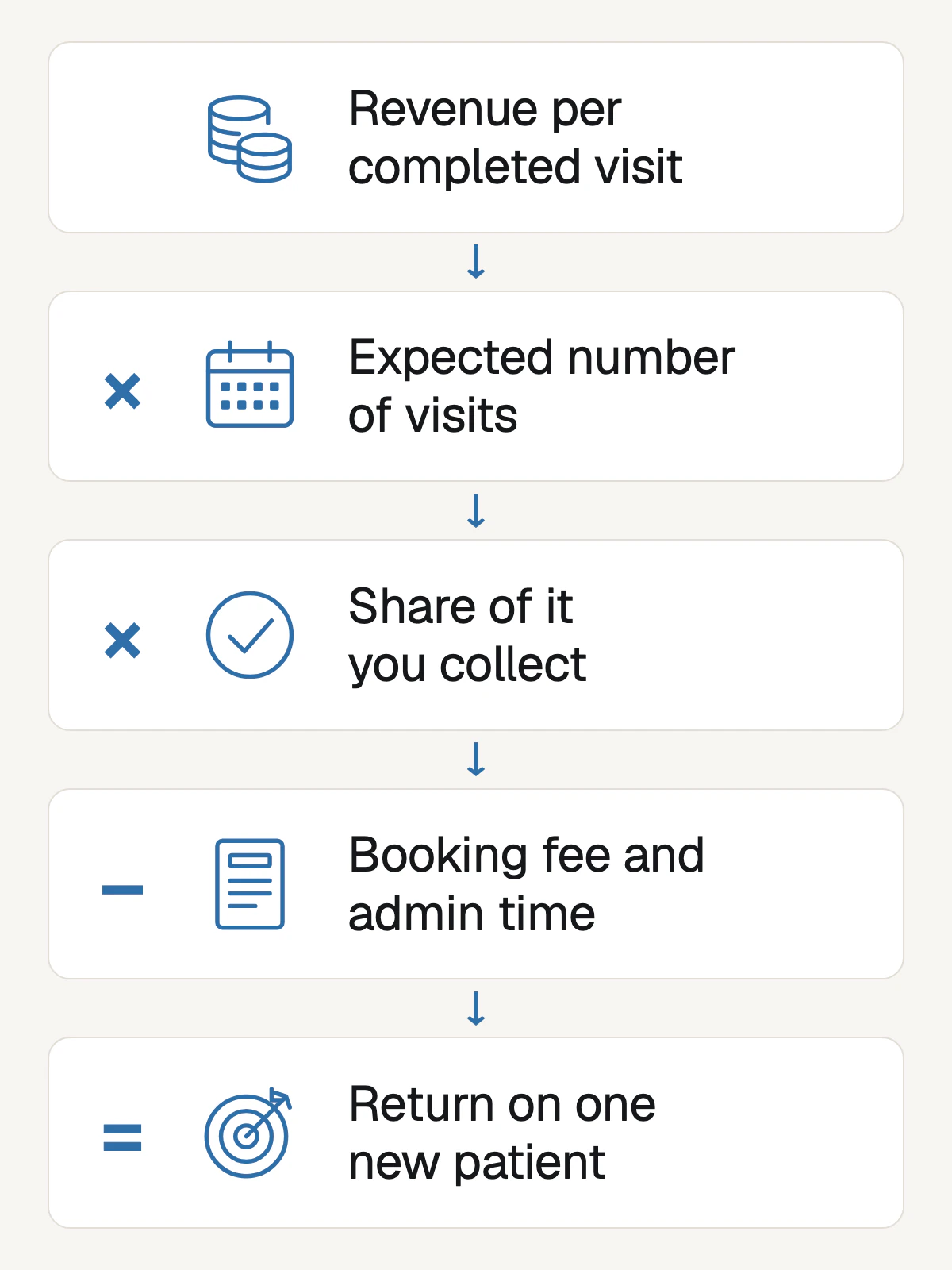
Say a new hygiene patient brings $200 per completed visit, comes in twice a year for 3 years, and you collect 95% of it. By Zocdoc's formula that patient is worth $1,140 to you before the booking fee and the admin time come off. The $200, the 6 visits and the 95% are our example: your own fee schedule and recall rate go in their place.
Zocdoc also warns that practices with few visits per patient, thin margins or mostly one-off visits may find the numbers harder to make work. A dental practice can run it per treatment, because years of check-ups and a single implant case put different numbers into the same formula.
Ask Zocdoc for the fee for your specialty and area, put your own visit value and visit count into the formula, and then compare the result with what any alternative costs you per booked and kept appointment.
Does Zocdoc work for dentists?
Dental groups use it: Zocdoc's provider page carries testimonials from marketing leads at 2 dental groups (Zocdoc for providers, read October 2026). The same page promises direct booking on Google, Healthgrades and insurance directories through one integration that keeps your availability in sync.
For a dentist the deciding number is the same as for anyone: the value of the treatments a new patient comes back for, against the fee for each Marketplace booking. Before you sign, search for a dentist in your own area on Zocdoc, the way a patient would, and count the practices on the first screen. Those are the plates next to yours.
Smith.ai: when calls go unanswered
Smith.ai answers your calls and books the appointments. Its scheduling page promises to catch every lead and book the appointment on the first call, around the clock (Smith.ai, read October 2026). The lead product is an AI receptionist, with live, North America-based agents as separate plans. The same page prices by the call: AI Receptionist plans from $0 a month for 25 calls, and AI-enhanced virtual receptionist plans from $300 a month.

Pick it when calls already arrive and some go unanswered, after hours or while the front desk is with a patient.
It leaves with you the job of creating new demand.
athenahealth: when the work is the patients you already have
athenahealth's patient engagement tools sit inside athenaOne, its practice platform. Its page lists patient self-scheduling, self check-in, online payments, outreach messaging, a live operator, and a proactive waitlist that tells patients about open appointments, same-day ones included (athenahealth, read October 2026). The specialties in its menu are medical ones, such as primary care, orthopedics and women's health.
Pick it when you run a medical practice and the workload is the patients you already have: scheduling, check-in, payments and filling same-day openings from the waitlist.
It leaves with you finding new ones.
Tebra: when patients want to book online and can't
Tebra's scheduling software lets patients book around the clock from your website and your online profiles, and Tebra says it builds for independent practices, not hospitals (Tebra, read October 2026). Scheduling is one part of a larger platform: records, billing, reminders and patient messaging, plus a marketing line for websites, SEO and reputation management. The specialties it links to are medical, such as family medicine, pediatrics and mental health.
Pick it when patients already want to book and your website can't take a booking.
It leaves with you creating new demand, beyond what its marketing line brings in.
Leadflix: when the calendar needs new booked consultations
We run the ads with footage from your practice, answer every new inquiry, qualify the patient and book the consultation into your own calendar, with the notes. The ad accounts and the CRM with your patient conversations are your practice's, and they stay yours if you leave. If you're buying booked consultations rather than software, here is what a booked appointment generation service should include.
We work with dental practices, med spas and aesthetic clinics, laser and skin clinics, hair restoration, injectables and surgical clinics: anywhere 1 new patient is worth a real number and the plan after the first treatment is worth more. The full setup is on our pages for dental practices and for med spas and aesthetic clinics.
On aesthetic accounts a new inquiry gets a reply within seconds of opting in, 7 days a week: a call where that is the right first touch for your clinic, a text where it isn't, and a person follows up. Dental practices get a text in under 5 minutes, 7 days a week, and a person follows up.
~70
Jacob Chen of Biohackr Health is in one of our 3 client films, the only one in English.
Pick it when you have open consultation slots week after week and want new patients who found your practice through your own ads.
It leaves with you the consultation itself: whether the patient says yes is up to your team.
If your calendar is already full for months ahead, you don't need more new patients from anyone on this list. Fix capacity or pricing first.
You can run 2 of these side by side
None of these rule out the others. Zocdoc's Book Online Button on your website and its Google button charge no booking fee, so a practice can pause Marketplace spend and keep online booking, add an answering service for the calls, or run its own ads next to a marketplace listing. Zocdoc's provider page also lists Zo, an AI phone assistant, and patient engagement tools, so ask what your Zocdoc account already covers before you add a second tool for the same job.
Before you switch, read the dashboard you already have: Zocdoc's shows bookings by source and appointment outcomes, completed visits, cancellations and no-shows. Put each source's cost next to its kept appointments, and the cheapest source per patient who shows up is the one to grow. Comparing agency proposals instead? Lay them side by side with the dental marketing packages checklist.
Straight answers to common questions
Is there an alternative to Zocdoc?
Yes, and which one fits depends on the bottleneck: an answering service such as Smith.ai if calls go unanswered, online booking on your own website if patients can't book, and a service that creates and books new patients if consultation slots sit empty. If you'd rather swap Zocdoc for another marketplace, ask what it charges and what counts as a billable booking, then run that through the same formula. A dental practice should ask athenahealth and Tebra whether they serve dentistry, because both list medical specialties on their pages.
Do providers pay to be on Zocdoc?
Not to be listed: Zocdoc says there are no upfront or subscription costs. A provider pays a one-time fee when a new patient books through the Zocdoc Marketplace or its affiliated partners, and Zocdoc bills Sponsored Results, its paid placement, separately.
How much does Zocdoc charge providers?
Zocdoc's pay-per-booking page gives doctors and dentists no dollar figure: it says the amount varies by specialty and location. Ask Zocdoc for the fee for your specialty and area before you sign, then run its value formula with your own visit value and visit count.
Is Zocdoc worth it for dentists?
It can be, when a new patient's value clears the booking fee. Zocdoc itself says the answer depends on specialty, patient retention and local demand, and dental groups appear among the testimonials on its provider page. Run the numbers per treatment, because a long-term hygiene patient and a one-time visit carry different values.
Does Zocdoc charge if a patient cancels or doesn't show up?
Zocdoc charges the fee at the moment of booking, and its page says the outcome of the visit doesn't change it. If a patient cancels within 24 hours of booking, Zocdoc may waive the fee without promising to, and if a patient who has already seen you through Zocdoc books as new, you have 7 days to claim a credit. For the no-shows themselves, here is how to reduce patient no-shows.
What are the disadvantages of Zocdoc?
For a provider, they sit in Zocdoc's own rules. Zocdoc charges the fee at booking whatever happens at the visit, so a patient who doesn't show still costs you the fee. Zocdoc bills Sponsored Results on top of the booking fees, and they don't count toward your monthly spend cap. For certain partner sites, it also enrolls you by default until you opt out.
How does Zocdoc make money?
From providers, by its own pages: a fee for each new-patient booking through its Marketplace and partners, Sponsored Results billed separately, and an Enterprise offer with no price shown. Booking from a practice's own website through Zocdoc's button carries no booking fee.
How does Leadflix charge compared with Zocdoc?
No price list, because the structure changes with the business. What's fixed: results-based, weighted to what a booked appointment is worth to you, no lock-in. You get a straight number on the call, before you commit to anything. Bring what Zocdoc charges you per booking, and we'll compare the two per patient who shows up.

Author
Oscar Cruz
Founder, Leadflix
Leadflix started when our founder, Oscar Cruz, saw that most gyms and trainers were terrible at marketing and started fixing it. Clinics and home improvement came next, where 1 new customer is worth enough that the math changes: fill the calendar and the business grows. 80+ businesses, $7M in client revenue and 40,000+ sales appointments later, that is still the whole job.
Articles by Oscar