Dental clinics
How to reduce patient no-shows: 7 fixes from the booking to the dental chair
The first fix comes before any reminder: the wait before the visit. What studies found, and when a fee is legal
To reduce patient no-shows, shorten the wait between the booking and the visit, book in the first conversation, send 2 text reminders that ask for a reply and name the slot you're holding, refill cancelled slots, and set a fee policy patients agree to before they book. Then count kept appointments, so you can see which fix works.
Across 105 studies, the average no-show rate in healthcare is "of the order of 23%" (Dantas et al., Health Policy, 2018). Reminders get most of the attention. Studies of booking records point to a lever that comes first: how many days the patient waits.
Below are the 7 fixes in the order a patient meets them, what the studies found where there is one, a policy template you can adapt, and when a fee is legal in the US and the UK.
Patient no-shows: what the 23% average hides
The 23% is an average across specialties and continents. At that rate, a day of 8 booked visits loses nearly 2 (illustrative arithmetic). An earlier version of the same review put dentistry at 19.6%, from only 5 studies (Dantas, 2016). Single clinics swing far wider: at the Tufts dental school, 38.97% of new-patient exams between 2015 and 2019 were no-shows (Kim et al., 2021).
The same review names the 2 predictors reported most often: a long lead time, the days between booking and visit, and a history of no-shows. Both are in your booking data today.
1. Shorten the wait between the booking and the visit
At Tufts, once the gap between booking and exam passed 5 days, the no-show rate rose to 49.79%. In a UK hospital dental service, patients who waited more than 180 days were 10 times as likely to miss as those seen within 30 days (Rodriguez et al., 2025).
For a new patient, keep consultation slots free inside the coming week, and offer the earliest one first. A patient who books for next Tuesday still remembers why they called. A patient who books 3 weeks out has time to book somewhere else.
If your chairs are booked solid for months ahead, more consultations won't help. Fix capacity or pricing first.
2. Book in the first conversation, with the reason in the notes
A patient who asks about a treatment and doesn't get an answer starts waiting before anything is booked. At the dental clinics we run this, the Patient Coordinator, one of the agents our team built, replies with a text in under 5 minutes, 7 days a week, qualifies the patient and books the consultation into your calendar with the notes. A person follows up. Nobody should hear from their dentist through a robot voice.
The first text itself, line by line, is in how to get new dental patients.
3. Send 2 text reminders, and ask for a reply
Reminders work, and 4 studies put a number on it:
| Trial, and what it compared | What it found |
|---|---|
| Cochrane review, 2013, 7 trials: text reminders against none | Attendance 78.6% with texts and 67.8% without, across the review, on moderate-quality evidence |
| Steiner et al., 2018, 54,066 patients: reminders 3 days and 1 day before, against one of them | 4.4% missed, against 5.8% (3 days only) and 5.3% (1 day only) |
| Ulloa-Perez et al., 2022, high-risk visits: a second text against one | 8.4% missed against 9.1% in primary care, 17.9% against 20.1% in mental health |
| Parikh et al., 2010, 9,835 patients: a call from clinic staff, an automated message, nothing | 13.6%, 17.3% and 23.1% missed |
None of these trials ran in a private dental practice. The dental evidence is mixed: in a review of orthodontic trials, patients who got reminders were less than half as likely to miss (Mohammed et al., 2019), while a trial at an Amsterdam orthodontic clinic found no effect (Bos et al., 2005).
Ask for a reply in every reminder. 3 days before: "Hi [name], your time at [clinic] is Tuesday at 9:00. Reply YES to keep it, or tell us a better time." The day before: "See you tomorrow at 9:00 at [clinic]. Can't come? Reply and we'll find you a new time." (Illustrative wording, not tested messages.) In a pediatric clinic's improvement project, 84% of the patients who missed had not confirmed (Set et al., 2022). An unconfirmed booking the day before is your cue to call.
In the US, HHS says appointment reminders "are considered part of treatment" and "can be made without an authorization" under HIPAA (HHS FAQ 286), and asks providers to limit what a message left for a patient discloses (HHS FAQ 198). Keep the treatment out of the text: the time, the place and your name are enough.
4. Put the cost of the slot in the reminder
The wording of the reminder changes the result. In the first of 2 trials at an English hospital trust, a text that stated the specific cost of a missed appointment to the health service cut the no-show rate from 11.1% to 8.4%, and the second trial repeated the result. Saying the same thing in general terms worked less well (Hallsworth et al., 2015).
For a private clinic the specific cost is the slot itself. Illustrative wording, not a tested message: "We've kept the chair for you for 45 minutes on Tuesday at 9:00." It names what is held, for how long, and when.
5. Make cancelling one reply, and refill the slot
A reminder turns some silent no-shows into cancellations. A systematic review found that reminder systems also lead more patients to cancel or move appointments they no longer want, and told clinics to build the steps that give those slots to other patients (McLean et al., 2016). A slot cancelled 2 days out can still go to another patient.
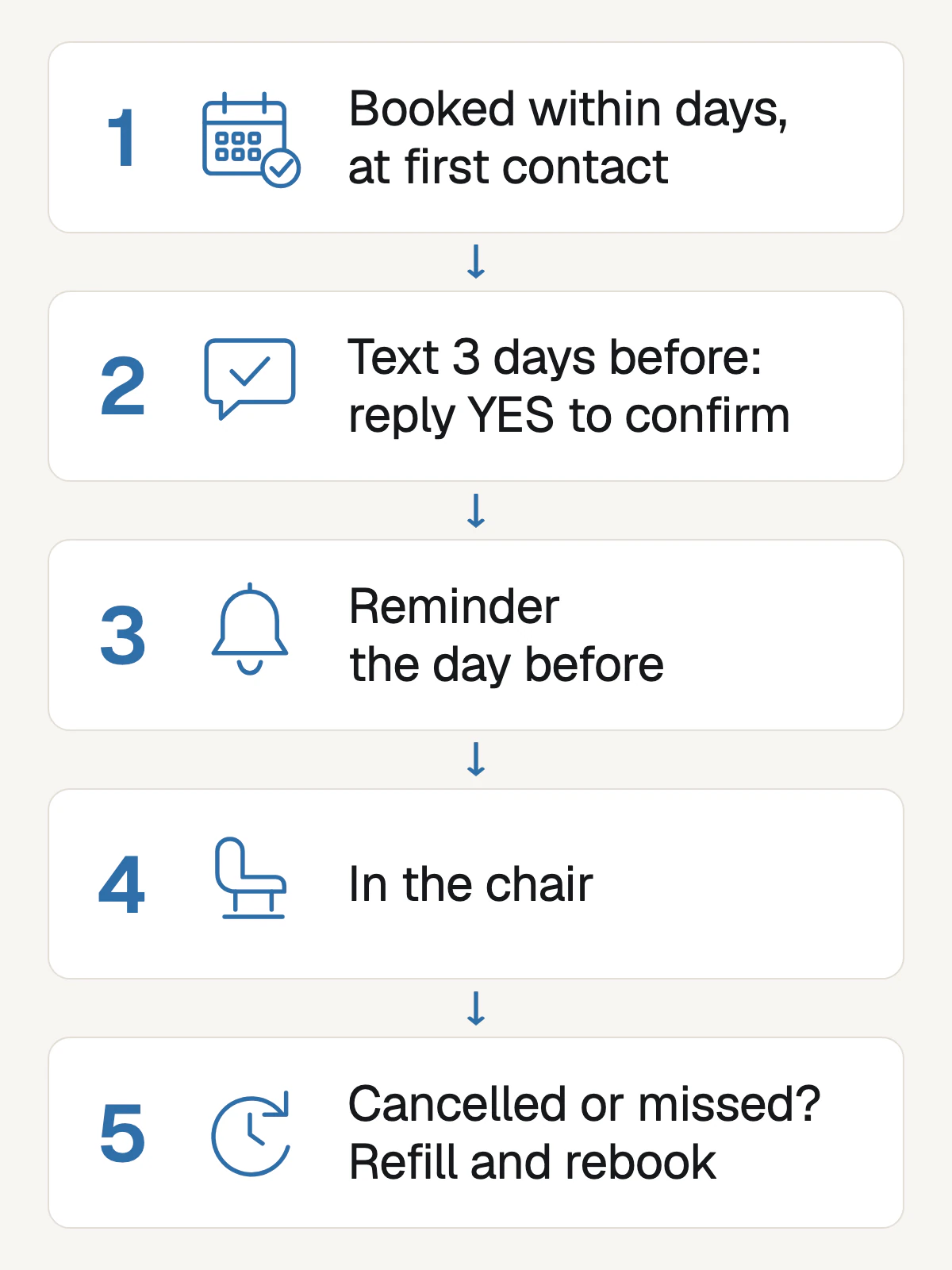
Keep a short list of patients who asked for an earlier time, and offer them the slot the moment it opens. For patients who miss again and again, the ADA suggests double-booking their appointments and warns that the practice has to adapt if they do show up on time (ADA, Patient Cancellations, read October 2026).
The patients who missed are still in your records, with everyone else who hasn't been back. On our accounts the Reactivation Agent picks a batch of past patients every day and writes each one a message that fits their history. A person approves it before it goes out.
Capillos, an aesthetic clinic we work with, shows what that list is worth: 10 treatments booked from past patients in month 1, through reactivation messages alone, before any ad spend.
6. Write a no-show policy patients agree to before they book
A fee protects the slot only when the patient knew about it first. The ADA suggests a fee for cancellations with less than 24 or 48 hours' notice, a policy in every new-patient package that the patient signs, and judgement in applying it, because a fee can damage the relationship with the patient (ADA, Patient Cancellations).
What the rules allow on a missed-appointment fee, read in October 2026 (not legal advice):
| Patient | May you charge for a missed appointment? |
|---|---|
| US Medicare | Yes, if you charge every patient the same way. The CMS manual allows it "provided that they do not discriminate against Medicare beneficiaries", and the fee is not billed to Medicare |
| US Medicaid | No. The ADA's Health Policy Institute notes that federal statutes and regulations keep Medicaid patients out of these charges (ADA HPI) |
| UK NHS dental | No. An NHS dentist "should not charge you a fee for missing NHS dental appointments" (NHS) |
| Private care | It depends on the agreement the patient accepted. In the UK a term that makes the patient pay "a disproportionately high sum" can be unfair (Consumer Rights Act 2015, Schedule 2); in the US, state rules and payer contracts apply too |
Fees don't fix attendance on their own: a 2023 review found the research on fines thin and its results inconsistent (Leibner et al., 2023). Use the fee to protect the slot, and the reminders and the short wait to fill it.
A no-show and cancellation policy template you can adapt
7. Count kept appointments, per ad and per source
A booking that never shows costs the same ad spend as one that does. Count booked consultations, kept appointments and accepted treatment plans per ad, and you'll see which source sends the most no-shows. The arithmetic, with a calculator, is in why cost per lead is the wrong number to optimize for.
That's how we report. We send the bookings and the kept appointments back to the ad platforms, so they look for more people who turn up.
Our job is to get the patient through your door. Whether they say yes to the treatment is up to your team.
43
Sam, who owns Gamla Staden Tandvård, is one of 3 clients on film, all 3 on one page.
If you're choosing who should run the booking for you, here is what a booked appointment generation service should include.
Straight answers to common questions
What is the average no-show rate for a dental office?
We found no measured rate for private practices. Across healthcare the average is about 23%, from a review of 105 studies, and an earlier version of the same review put dentistry at 19.6% from only 5 studies. Single clinics vary widely: a US dental school saw 38.97% of new-patient exams missed. To measure yours, divide the missed appointments by the booked appointments for the same month.
Can a dentist charge a no-show fee?
Yes, if the patient agreed to it before booking. The ADA suggests a fee for late cancellations, set out in a policy every new patient signs and applied the same way to all of them. In the US you generally can't charge Medicaid patients, and Medicare allows it only when non-Medicare patients pay the same; in the UK, NHS dentists should not charge for a missed NHS appointment. This is not legal advice.
How many appointment reminders should a clinic send?
A trial of 54,066 patients supports 2: patients reminded 3 days and 1 day before missed 4.4% of appointments, against 5.8% and 5.3% with only one of the two. Reviews disagree on the best timing, so ask for a reply and call the patients who don't answer.
Do text reminders work as well as phone calls?
The Cochrane review found texts and calls had a similar effect. A trial in an academic practice found a call from clinic staff beat an automated message, 13.6% missed against 17.3%. Texts cost less to send; a person's call suits the patients who don't reply.
Why do patients miss appointments?
A review of 105 studies found the predictors reported most often were a long wait between booking and visit and a history of no-shows. Younger adults, patients of lower socioeconomic status, those living far from the clinic and those without private insurance missed more often (Dantas et al., 2018).
What should a dental no-show policy say?
How much notice you need, how to cancel, what a missed appointment costs, that the fee is the same for every patient, and that you tell the patient before you charge. Put it in the new-patient paperwork and have the patient sign it, as the ADA suggests.
What can a marketing agency change about no-shows?
The 2 steps it runs: how fast a new inquiry is answered and booked, and which ads bring the patients. On our dental accounts a new inquiry gets a text in under 5 minutes and is booked with the notes, and a person follows up. We count kept appointments per ad and send them back to the ad platforms.
Do deposits reduce no-shows for aesthetic consultations?
The evidence is thin. Software vendors claim large effects, and one uncontrolled hospital pilot in Singapore went from 9.1% to 4.3% no-shows after adding deposits, along with other changes (CHI Singapore). If you take a deposit, say so before the booking, and refund or credit it on the terms you published.

Author
Oscar Cruz
Founder, Leadflix
Leadflix started when our founder, Oscar Cruz, saw that most gyms and trainers were terrible at marketing and started fixing it. Clinics and home improvement came next, where 1 new customer is worth enough that the math changes: fill the calendar and the business grows. 80+ businesses, $7M in client revenue and 40,000+ sales appointments later, that is still the whole job.
Articles by Oscar